
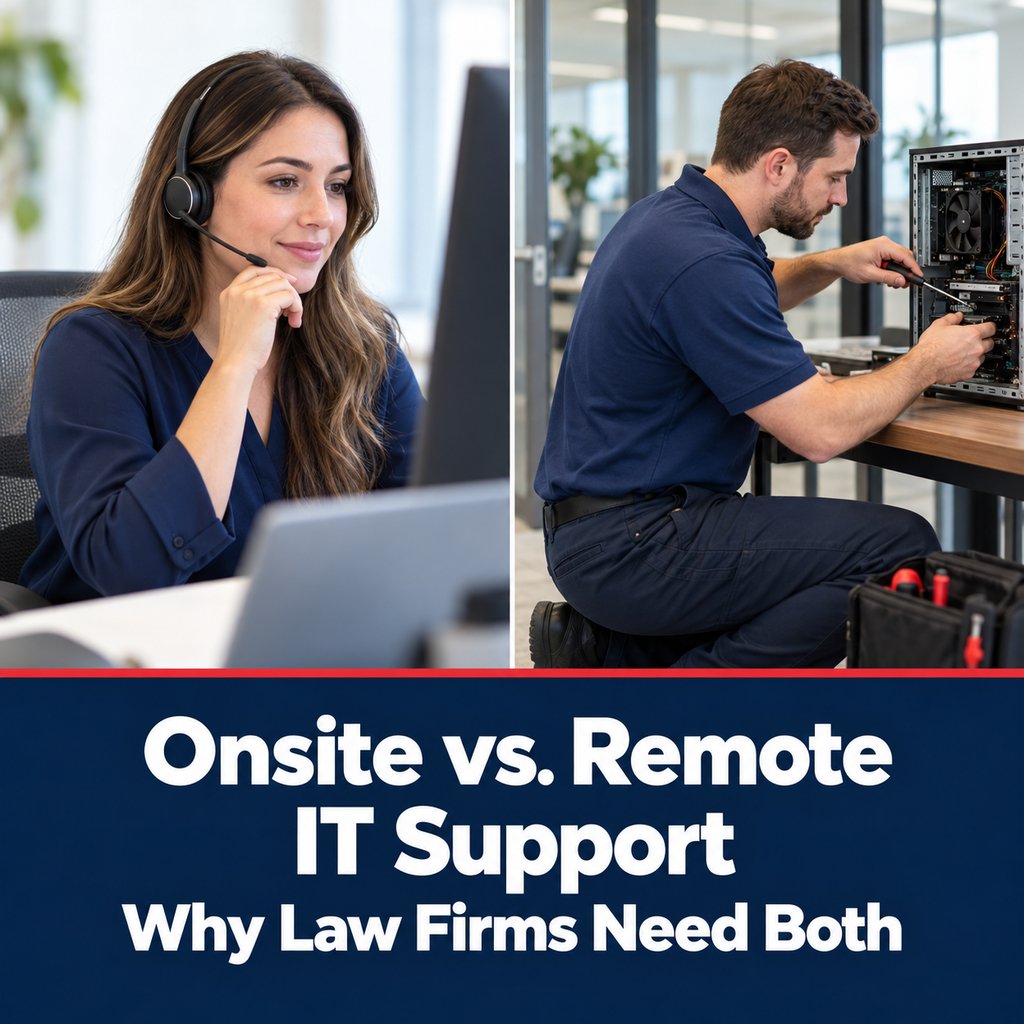
Most day-to-day IT issues can be resolved remotely, and that's exactly what most managed IT providers are built around. The gap shows up in the smaller category of problems that genuinely require a person, in the building, with hands on the equipment - and firms often don't find out whether their provider can actually do that until the moment they need it.
What Remote Support Handles Well
Software issues, most account and access problems, routine monitoring, and a large share of troubleshooting can be handled remotely, quickly, and without anyone needing to be on-site. For firms, this is often the majority of support activity in a given month, and remote-first support is genuinely efficient for it.
Where Remote-Only Support Runs Out
- Hardware failures - a server, switch, or workstation that physically needs to be replaced or repaired
- Cabling and network wiring issues
- New equipment installation or office moves
- Physical security issues affecting servers or network equipment
- Situations where a remote technician's usual fix hasn't worked and diagnosis requires being in the room
A provider whose model is exclusively remote either can't help with these directly, or has to subcontract or delay - neither of which is obvious from a sales conversation.
The Question to Ask Directly
Rather than asking whether a provider offers on-site support in general terms, ask what actually happens when something requires a technician in the building: how quickly, and is it their own technician or a subcontractor they're coordinating on the fly? The specificity of the answer tells you more than the marketing material does.
Distance Is a Practical Constraint, Not Just a Preference
A provider that's structured to actually show up - not just promise to - is usually one that has deliberately kept its service area close enough to make that realistic. That's a genuine constraint on how many firms a provider can serve well, and it's worth treating a provider's honesty about that limitation as a point in their favor, not against them.
Frequently Asked Questions
Is remote-only IT support ever adequate for a law firm?
It can be adequate for firms whose infrastructure and needs rarely require physical intervention, but most firms eventually hit a situation - a hardware failure, a cabling issue, an office move - where on-site presence matters, and it's worth knowing in advance whether your provider can actually deliver that.
How do we find out whether our current provider actually offers on-site support, or just says they do?
Ask directly what happens, step by step, when an issue requires someone in the building - who comes, how quickly, and whether it's an employee or a subcontracted third party.
Does on-site support cost significantly more than remote-only support?
It varies by provider and contract structure. The more useful comparison isn't the price difference in isolation, but what a firm loses in downtime and delay when on-site help isn't actually available when it's needed.
Why does a provider's service radius matter if they say they'll come on-site?
A provider covering a wide geographic area with a small technician team often can't realistically get on-site quickly. A tighter service area is frequently a sign the provider has structured itself to actually make on-site visits practical rather than aspirational.
Next Step
If you'd like a plain, specific read on how your firm would actually hold up - rather than an assumption - we offer a 15-minute call to see if we're a fit. No pitch, no obligation.
Managing partners and office administrators can reach us at 325-643-8184 or through the contact form at apollocomputers.com.