
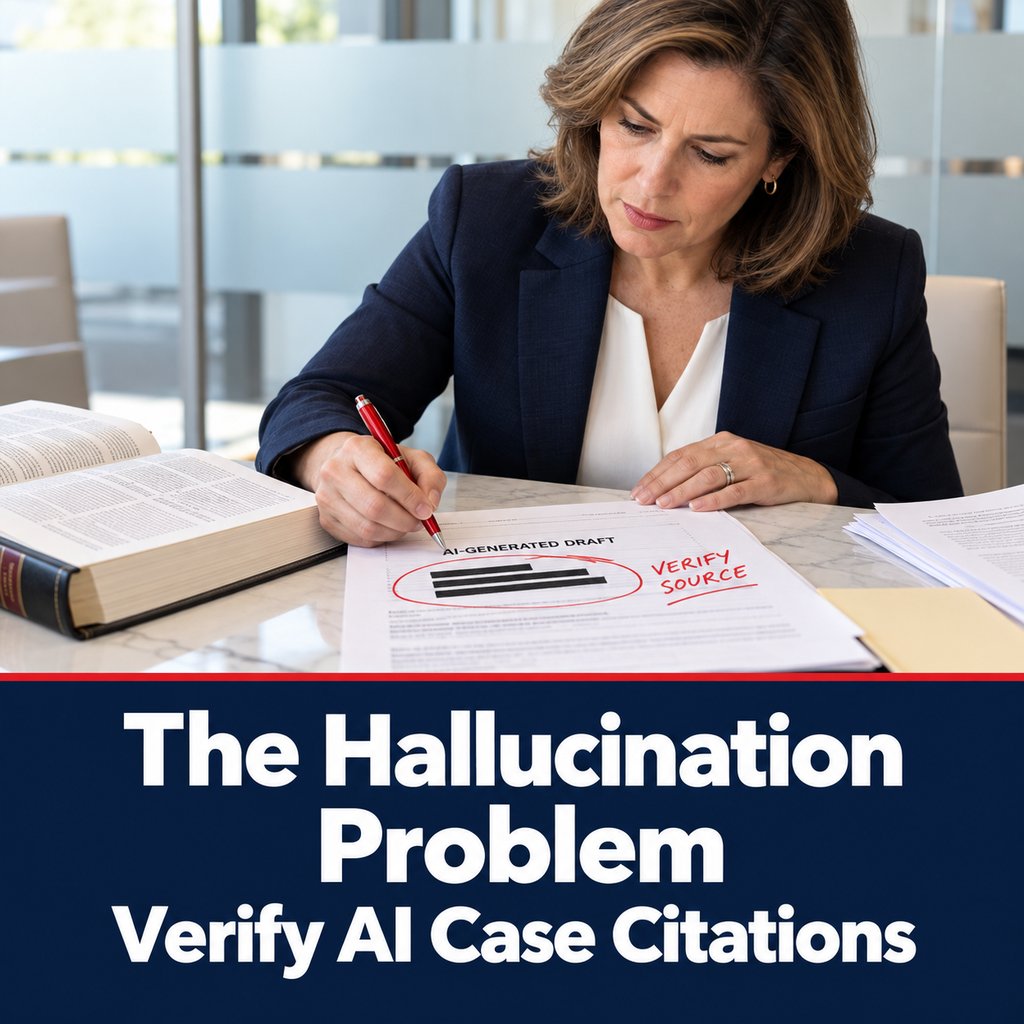
Multiple courts have now sanctioned attorneys for filing briefs containing case citations that simply don't exist - invented by an AI tool and never checked before submission. This isn't a rare, one-off failure. It's a predictable result of how generative AI tools work, and it's worth understanding exactly why, because the same failure can happen in any firm that treats AI output as a finished answer.
Why AI Tools Invent Citations in the First Place
Generative AI tools are built to produce plausible-sounding text, not to verify facts against a database of real cases. When asked for a citation supporting a legal argument, the tool generates something that reads exactly like a real citation - correct format, a believable case name, a plausible court and year - because that's what the pattern is supposed to look like. Nothing in that process checks whether the case actually exists.
This is why the failure is so easy to miss. A fabricated citation doesn't look wrong. It looks exactly as credible as a real one, right up until someone tries to pull up the actual case.
What's Actually Happened in Court
Judges in multiple jurisdictions have issued sanctions after discovering that briefs filed by attorneys contained citations to cases that don't exist, or that misstated the holdings of real cases the attorney never actually read. In each instance, the underlying issue was the same: AI-generated content was filed without independent verification.
The One Step That Prevents This
- Every citation produced by an AI tool gets pulled up and read in an actual legal database before it goes into a filing
- AI-assisted drafts are treated as a first draft requiring the same scrutiny as work from a first-year associate - never as a finished product
- Staff are told explicitly that AI tools can produce confident, fluent, entirely fabricated content, so the risk is named rather than assumed to be obvious
None of this requires avoiding AI tools. It requires treating their output the way a firm would treat any other unverified source - useful as a starting point, not as a substitute for checking the underlying case law.
Frequently Asked Questions
Is this only a risk with free or lower-quality AI tools?
No. Fabricated citations have appeared from well-known, widely used AI tools, including ones marketed specifically for legal research. The behavior is a function of how these tools generate text, not a defect limited to any one product.
How common is this problem, really?
It has happened enough times, across multiple courts and firms, that it's now treated as a known and documented risk rather than an unusual fluke - which is exactly why a verification step matters regardless of which tool a firm uses.
If an AI tool is specifically built for legal research, is it safe to trust its citations without checking?
Even tools built specifically for legal research can still produce errors, and the professional responsibility obligation to verify a citation before filing it doesn't change based on which tool produced it.
What's a simple policy a firm can put in place right away?
A short rule that any AI-assisted citation must be independently pulled up and confirmed in a legal database before it appears in a filing - and that no AI-generated work product goes out the door without attorney review.
Next Step
If you'd like a plain, specific look at how your firm's current setup actually stacks up, we offer a 15-minute call to see if we're a fit. No pitch, no obligation.
Managing partners and office administrators can reach us at 325-643-8184 or through the contact form at apollocomputers.com.