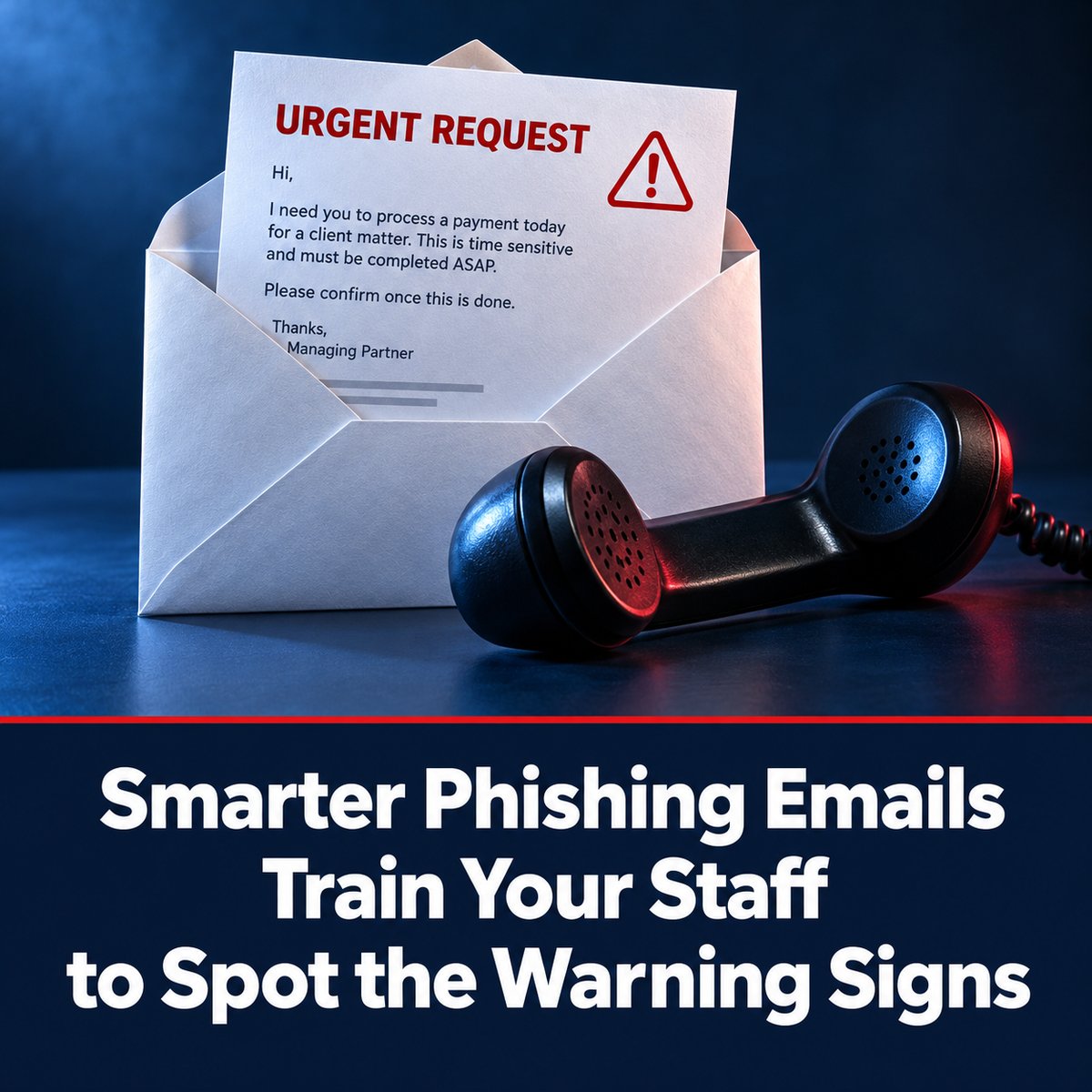
Not long ago, a phishing email was easy to recognize. The grammar was off, the greeting was generic, and the request made little sense. Those tells are disappearing. Messages now arrive well written, correctly addressed, and timed to fit what the recipient is actually working on.
For a law firm, the consequences are serious. A single staff member who enters a password on a fake login page, or acts on a fraudulent payment instruction, can expose privileged client communications, interrupt the firm's work for days, or send money to the wrong place.
What Law Firms Are Seeing
The most effective phishing is not broad. It is aimed at a particular firm and a particular kind of work. Common patterns include:
- Messages that appear to come from a partner or the office administrator asking for something urgent, such as a favor, a gift card purchase, or a quick transfer
- Fake document-sharing notices that look like they came from a client, opposing counsel, or a court, linking to a login page that captures the staff member's credentials
- Payment-instruction changes sent during a real transaction, asking that funds go to a different account
- Login prompts and verification requests that arrive when no one was trying to sign in, in the hope that someone will approve one just to make it stop
What these have in common is that they look like ordinary legal work. Law firms exchange documents, receive urgent requests, and handle money for clients every day, so a convincing message rarely feels out of place.
What Staff Should Actually Watch For
Because the spelling mistakes are gone, training needs to focus on behavior rather than appearance. A few signals are worth building into the firm's habits:
- Urgency or pressure, especially a request that discourages the person from checking with anyone else
- Any request to change how money is sent, even when the message looks like part of a conversation already underway
- An unexpected link or attachment, particularly one that asks the person to sign in to view it
- A sender address or website that is close to the real one but not identical
- A request to skip a normal step, such as approvals the firm usually requires
The most reliable defense is a simple rule: when a message asks for money, credentials, or sensitive files, confirm it through a different channel, such as a phone call to a number already on file. That one habit defeats a large share of these attempts, however polished the message looks.
Training That People Will Actually Absorb
Annual training sessions tend to be forgotten by the following month. Short, regular reminders work better, and so do realistic practice messages sent by the firm's IT provider so staff can see what a convincing attempt looks like in a safe setting.
How the firm treats mistakes matters just as much. If someone who clicks a bad link is embarrassed or reprimanded, the next person who clicks one will keep quiet about it, and the firm will lose the first few hours when a quick report would have helped the most. Staff should know exactly how to report a suspicious message or a mistaken click, and that reporting quickly is the right thing to do.
Training Is One Layer, Not the Whole Defense
Even well-trained staff will sometimes be fooled, which is why the technology behind them matters. Email filtering catches much of what never needs to reach an inbox. Multi-factor authentication means that a stolen password alone is not enough to get into the firm's systems. Monitoring helps spot unusual sign-ins early, and tested backups mean that a successful attack does not turn into a lost week.
This is the gap between what a firm assumes is covered and what is actually in place. It is worth confirming with whoever manages the firm's IT which of these protections are active today, rather than assuming.
Frequently Asked Questions
How can staff tell whether an email is a phishing attempt?
Look at behavior more than appearance. Urgency, requests to change payment details, unexpected links that ask for a sign-in, and pressure to skip normal steps are all warning signs. When in doubt, confirm the request by phone using a number the firm already has.
How often should a law firm train staff on phishing?
Short, regular reminders tend to work better than a single annual session. A brief refresher automatically sent every month, combined with realistic practice messages, helps staff keep the habits fresh without taking much time away from billable work.
What should someone do after clicking a suspicious link?
Report it right away to whoever manages the firm's IT, and do not wait to see if anything happens. Changing the password and checking the account for unusual activity are usually among the first steps. Quick reporting limits the damage, so the firm should make it easy and blame-free.
Does multi-factor authentication stop phishing?
It helps considerably, because a stolen password alone is no longer enough to sign in. It is not a complete defense, since attackers sometimes trick people into approving a sign-in request, which is why staff should also be trained to decline prompts they did not initiate.
Are law firms really targeted more than other businesses?
Law firms hold privileged information and often handle client funds, which makes them attractive targets, and the volume of routine document and payment requests makes fraudulent messages easier to hide. Firms should plan on being targeted.
Next Step
If you would like a plain look at which email protections your firm actually has in place today, we offer a 15-minute call to see if we're a fit. No pitch, no obligation.
Managing partners and office administrators can reach us at 325-643-8184 or through the contact form at apollocomputers.com.