
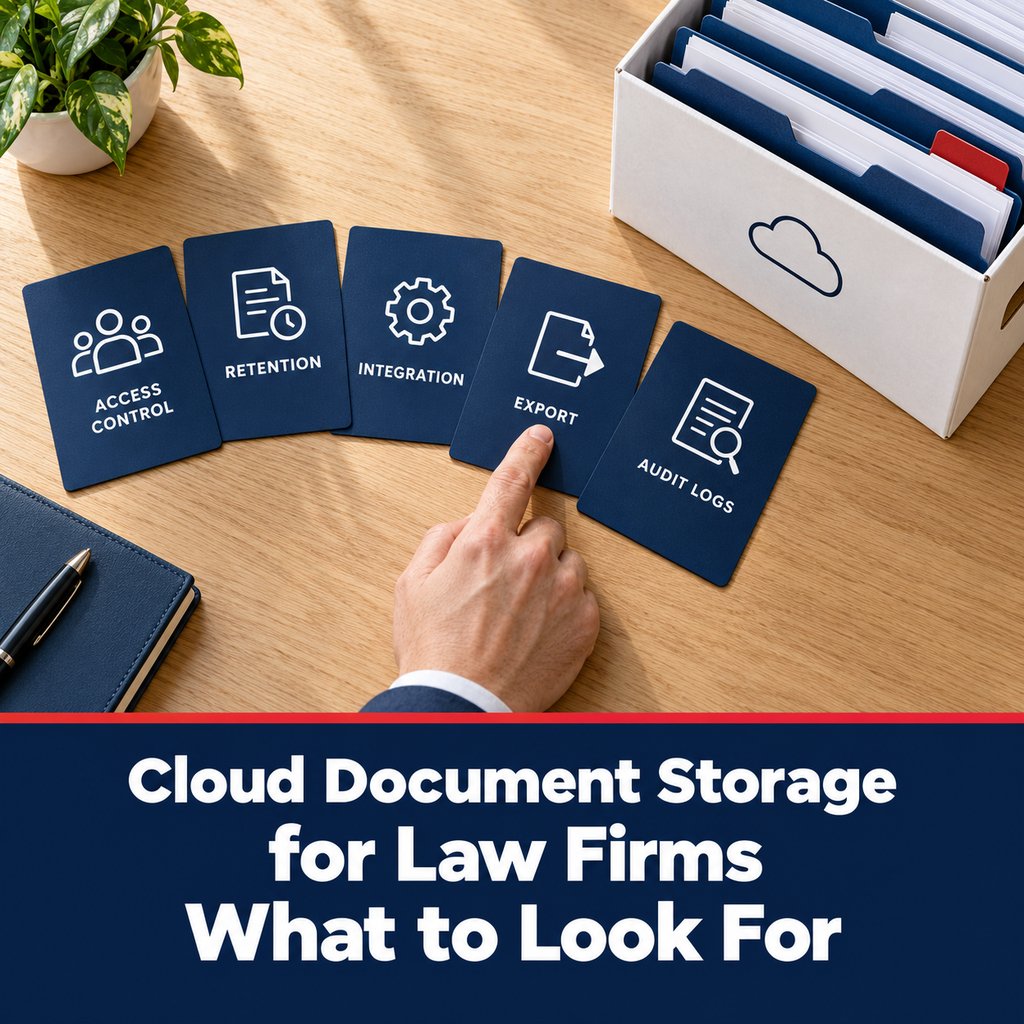
Cloud document storage has become close to a baseline expectation for a modern law practice, but "cloud storage" covers a wide range of products built for very different purposes. A tool designed for general consumer file sharing and one designed for regulated professional use can look similar on the surface while being very different underneath.
What to Actually Look For
- Granular, matter-level access control - not just one shared firm-wide folder structure
- A clear, written data retention and deletion policy, so the firm knows exactly how long files are kept and what happens when a matter closes
- Integration with the practice management or document management system the firm already uses, so files aren't scattered across multiple disconnected tools
- A straightforward way to export everything if the firm ever needs to leave the platform
- Audit logging - a record of who accessed or changed a given file, and when
Red Flags Worth Avoiding
- Vague or missing language about who can access firm data and for what purpose
- No meaningful distinction between personal and business-tier accounts - a tool built primarily for individual consumer use rarely has the access controls a firm actually needs
- No audit trail showing who touched a file or when
- Difficulty exporting data in bulk if the firm decides to switch providers later
None of these red flags are necessarily disqualifying on their own, but more than one of them together is a sign the tool wasn't built with a regulated profession's needs in mind.
Fit Matters More Than Features
The most feature-rich platform on the market isn't automatically the right one for a given firm. A solo practitioner and a fifteen-attorney firm have different access-control needs, different volumes of data, and different integration requirements with the practice management software already in place. The right question isn't "which platform has the most features," but "which platform fits how this specific firm actually works."
Frequently Asked Questions
Is a well-known consumer cloud storage brand good enough for a law firm?
It depends entirely on the specific tier and configuration in use. Many consumer-facing brands also offer business or enterprise tiers with meaningfully different access controls and data handling terms - the brand name alone doesn't answer the question.
How important is integration with our existing practice management software?
Fairly important in practice. Files scattered across a storage tool that doesn't talk to the firm's case management system tend to get duplicated, lost track of, or stored inconsistently by different staff.
What should happen to client files when a matter closes?
That should be governed by a clear, written retention and deletion policy - ideally one the firm has set deliberately, rather than files simply accumulating indefinitely by default.
Can an outside IT provider help evaluate a specific cloud storage option?
Yes - reviewing a specific platform's access controls, data handling terms, and fit with a firm's existing systems is a reasonable part of due diligence before adopting or switching providers.
Next Step
If you'd like a plain, specific look at how your firm's current setup actually stacks up, we offer a 15-minute call to see if we're a fit. No pitch, no obligation.
Managing partners and office administrators can reach us at 325-643-8184 or through the contact form at apollocomputers.com.