
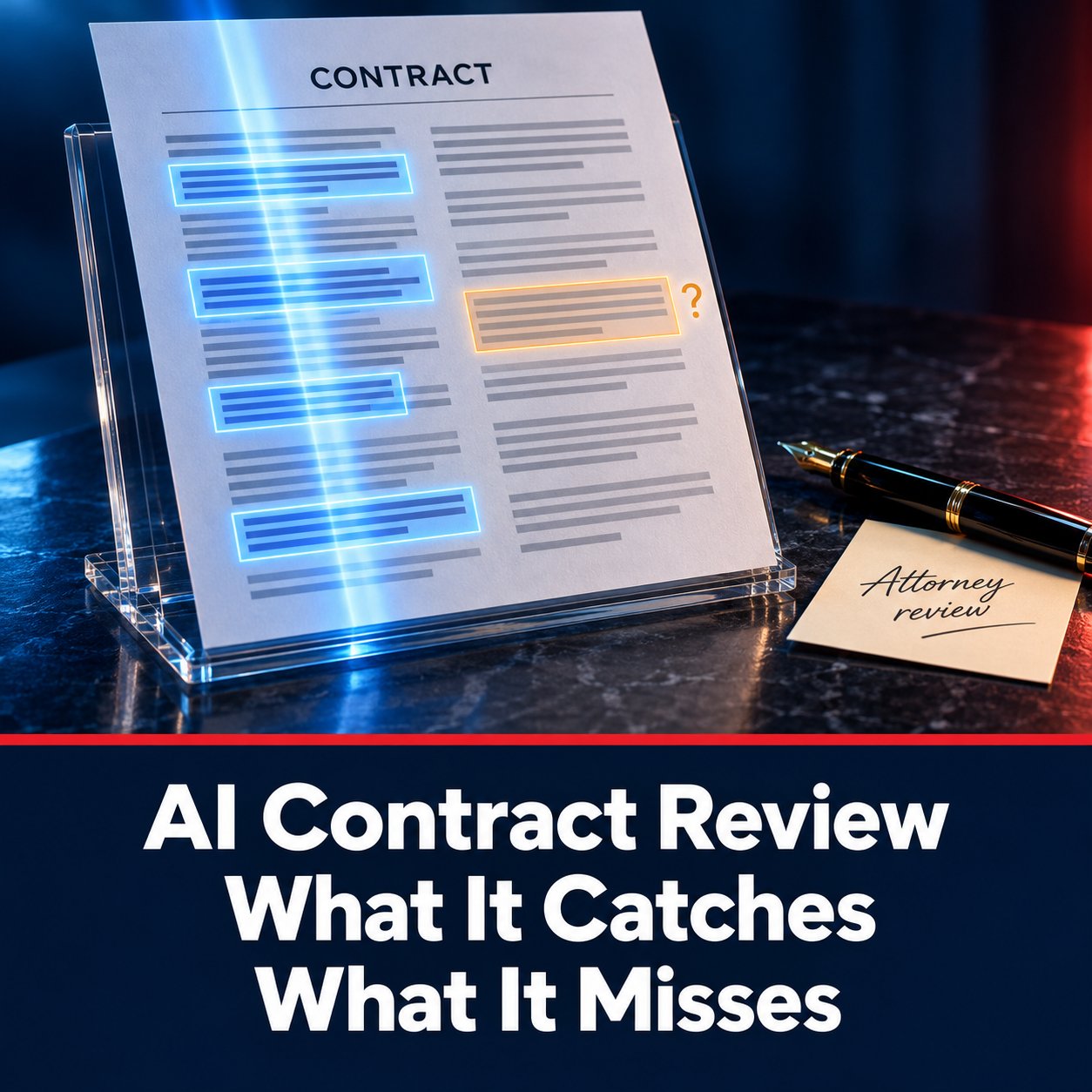
Contract review is one of the first places law firms look when they consider AI. The work is repetitive, document-heavy, and billed in hours that clients increasingly question. The tools are real, and some of them are useful. They are also routinely described in terms that go further than what they reliably do.
Understanding the difference is worth doing before a firm runs a client's agreement through one.
What These Tools Do Well
Contract review tools are strongest at structured, repeatable tasks, the kind that consume a first pass:
- Locating specific clauses, such as indemnification, termination, governing law, and assignment, across a large stack of agreements
- Comparing a draft against the firm's preferred language or a checklist and flagging where it departs
- Noticing when a standard provision is missing altogether
- Pulling dates, parties, renewal terms, and obligations into a summary or table
- Catching internal inconsistencies, such as a defined term that is used but never defined, or a cross-reference that points to the wrong section
That is a real time saving. Work that might take a paralegal or junior associate hours to locate and tabulate can be organized in minutes, so the attorney starts from a structured view instead of a blank page.
What They Miss
A contract review tool reads the document in front of it. It does not know your client. It does not know that the counterparty has a history of disputing payment terms, that this client cares more about closing quickly than about the liability cap, or that a clause that is routine in one industry is a problem in another.
- Business context and leverage: which terms actually matter for this client in this deal
- What is absent when the tool was not told to look for it: a tool checks against the standards it has been given, not against the risks no one thought to specify
- Jurisdiction-specific issues, such as whether a restrictive covenant or venue clause will hold up in Texas
- Ambiguous drafting, where the risk lies in how a court would read the language rather than in what the words say on their face
- How several documents interact, such as a master agreement, an amendment, and an exhibit that each modify the others
- Poor scans, handwritten markups, and heavily revised tracked-changes documents, which can be read incompletely or wrongly
There is also the problem of confident error. AI tools can summarize a contract and state something the document does not say, and the summary will read just as smoothly as an accurate one. This is the same weakness that has led to sanctions over fabricated case citations, and it is the reason the output has to be checked against the contract itself.
The Question That Comes Before Accuracy: Where Does the Contract Go?
A client's contract is confidential. Uploading it to an AI tool means the document leaves the firm's own environment and goes to a vendor. Before that happens, the firm should be able to answer a short list of questions:
- Does the vendor use uploaded documents to train its models, or keep them for any purpose beyond the review itself?
- How long are documents retained, and can the firm have them deleted?
- Where is the data stored, and who at the vendor can access it?
- Can access be restricted by matter, and is there a record of who uploaded and reviewed what?
- Do logins require multi-factor authentication, and are they tied to firm accounts rather than personal ones?
The answers often differ between a vendor's consumer product and its business agreement, even when the interface looks the same. The terms the firm actually signs are the ones that count.
Where Responsibility Stays
Bar guidance on AI has been consistent on one point: the attorney remains responsible for the work. An AI tool is something to be supervised and checked, not a delegate whose output can be relied on unread. The practical standard is that the tool performs a first pass and an attorney reads the contract.
It also helps for the firm to decide which tools are approved. When there is no decision, staff tend to choose their own, and the firm then has client documents sitting in tools no one has vetted.
A Sensible Way to Start
A firm considering one of these tools can test it without putting client material at risk. Start with the firm's own form agreements or sample documents that contain no client information. Then have an attorney compare the tool's output against a review already completed on a closed matter. The comparison will show quickly where the tool is dependable and where it is not, which is more useful than any vendor demonstration.
Frequently Asked Questions
Can AI contract review replace an attorney's review?
No. These tools are useful for locating clauses, flagging deviations, and organizing a first pass, but they do not understand the client's goals or leverage, and they can state errors with confidence. An attorney still needs to read the contract.
Is it safe to upload client contracts to an AI review tool?
It depends on the vendor's actual terms. The firm should confirm whether uploaded documents are used for model training, how long they are retained, where they are stored, and who can access them. Those answers frequently differ between a consumer product and a business agreement.
Do these tools work on scanned documents?
Results vary. A clean, text-searchable document is read far more reliably than a poor scan or one with handwritten markups. Any document that was not read cleanly is one the attorney should check more closely.
How should a firm evaluate a contract review tool before buying it?
Test it on the firm's own form agreements or non-client samples, and compare its output against a review an attorney has already completed. This shows where the tool is reliable without exposing client material.
Who at the firm should decide whether an AI tool is approved?
Typically the managing partner or office administrator, with input from whoever manages the firm's IT. The decision should cover both whether the tool is useful and whether the way it handles client data is acceptable.
Next Step
If your firm is working through whether and how to bring an AI tool into your practice, we're happy to have a short conversation about the security and IT governance questions worth asking before you commit. We're not AI tool experts - we're IT professionals who help firms protect their systems and their client data.
15 minutes, no pitch, no obligation.
Managing partners and office administrators can reach us at 325-643-8184 or through the contact form at apollocomputers.com.