
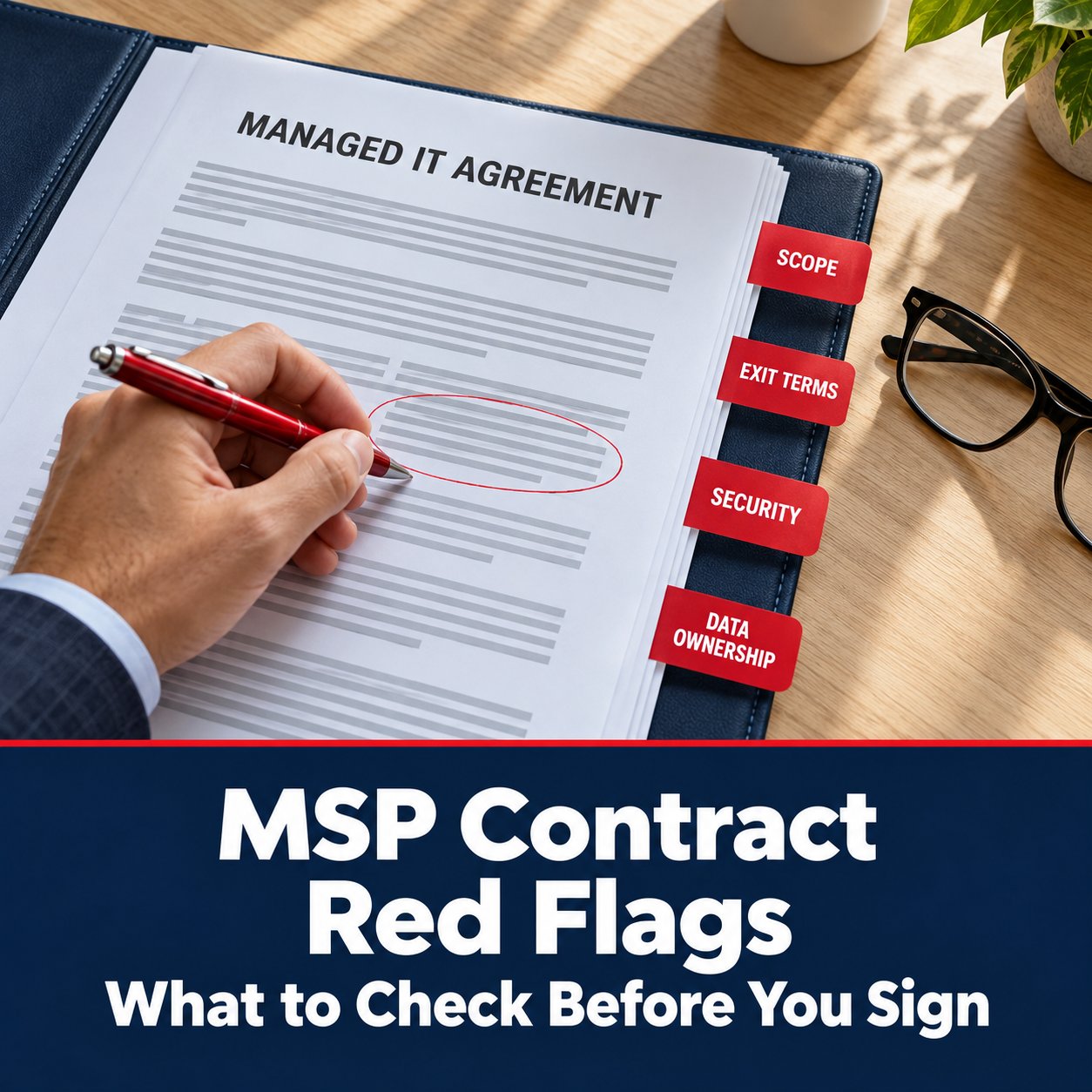
For many firms, a managed IT agreement is signed after the sales conversation has already done most of the persuading. The contract is where the real commitments live, and it is often read less carefully than an office lease.
This is not legal advice, and the firm's own counsel should review any agreement before it is signed. It is a list of patterns that are worth noticing, whether the firm is choosing a provider for the first time or reviewing the one it already has.
Scope That Is Vague About What Is Covered
Phrases like "full IT support" or "comprehensive coverage" mean very little unless the agreement says what they include. The exclusions are often in an appendix, and the line between what the monthly fee covers and what is billed separately is sometimes left deliberately soft.
A clear agreement states what is maintained and monitored under the monthly rate, and how new equipment or software is handled when the firm adds it. If the firm cannot tell from the document what a typical month will cost, the scope is not clear enough.
Promises That Exist Only in the Sales Conversation
Monitoring, backup testing, and response expectations are frequently described verbally and then missing from the signed agreement. Whatever the firm is relying on should be written down. If a provider says backups are tested, the agreement should say so. If a provider is reluctant to put a commitment in writing, that reluctance is itself useful information.
Unclear Data Ownership and Exit Terms
Few firms think about leaving a provider on the day they sign, and that is exactly when the exit terms are easiest to negotiate. The questions worth asking:
- Who holds the administrator credentials, the network documentation, and the backups?
- What does the provider hand over if the relationship ends, and in what format?
- Does the agreement renew automatically, and how far in advance must the firm give notice to stop it?
- Are there penalties for ending early, and do they grow with the length of the term?
A firm that cannot get its own credentials and documentation back from a provider is not really in control of its own systems.
Security Described in General Terms
"Robust cybersecurity" and "advanced threat protection" are descriptions, not commitments. A firm should be able to find specific controls in the agreement, such as multi-factor authentication, patching, continuous monitoring, and backup testing, along with who is responsible for each.
This matters most at the point where a firm's assumptions and its actual protection diverge. That gap tends to surface only during a breach or a cyber-liability claim, which is the worst moment to learn that a control listed on an insurance application was never in place. A contract that spells out the controls gives the firm something it can show a carrier, a client, or a court.
No Mention of Confidentiality
A law firm's duty of confidentiality extends to the vendors that touch its systems. The agreement should address who at the provider can access firm data, whether any work is subcontracted, and how quickly the provider will notify the firm if something goes wrong on its side. A provider that is unwilling to sign a confidentiality agreement, or to comply with the firm's own security requirements, is one to reconsider.
Nothing That Reflects How a Law Firm Works
A provider that treats a law firm like any other small business will usually show it in the contract. There may be no reference to practice management software, document management, or the deadlines that make downtime costly for an attorney. The firm should also ask who actually shows up when something cannot be fixed remotely. A meaningful share of problems, roughly 15 percent in our experience, cannot be resolved without someone on site, and some providers have no one nearby to send.
Terms Worth Having Your Own Counsel Read
Limitation of liability, indemnification, and insurance requirements tend to be the dense part of any services agreement. A cap that limits the provider's responsibility to a small fraction of what a failure could cost the firm is worth discussing before signing, not after. These are legal questions, and they are best answered by the firm's own attorneys and, where relevant, its insurer.
A Simple Test
After reading the agreement, the managing partner or office administrator should be able to explain in a couple of sentences what the firm is paying for and what happens when something fails. If that is not possible, the agreement is not clear, and it is better to ask the provider to make it so before signing than to find out during an outage.
Frequently Asked Questions
How long should a managed IT contract term be?
There is no single right length. What matters is whether the term is paired with reasonable exit terms. A long commitment combined with early-termination penalties and automatic renewal limits the firm's options if service falls short.
Should our attorneys review an MSP agreement?
Yes. A managed IT agreement governs access to the firm's systems and client data, and it contains liability, indemnification, and confidentiality terms that a firm's own counsel is well placed to evaluate.
Is a flat monthly fee always better than hourly billing?
A flat rate makes costs predictable, but only if the scope is clearly defined. The agreement should state what the monthly rate covers and how additional equipment or software is scoped and priced separately.
What should happen to our data and administrator credentials if we leave a provider?
The agreement should state that the firm retains ownership of its data, credentials, and network documentation, and describe what the provider hands over and how. If this is not addressed, raise it before signing.
Is it a red flag if a provider says it may not be the right fit for our firm?
Not necessarily. A provider that is candid about a mismatch, such as a firm outside the area it can serve well, is giving useful information. The warning sign is a provider that agrees to everything but puts very little in writing.
Next Step
If you are comparing providers or reviewing a current agreement and want a plain look at what it does and does not cover, we offer a 15-minute call to see if we're a fit. No pitch, no obligation.
Managing partners and office administrators can reach us at 325-643-8184 or through the contact form at apollocomputers.com.